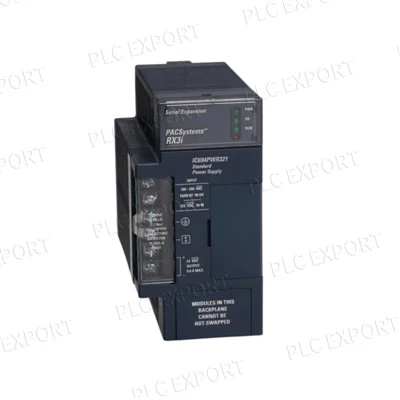
A PLC module, or Programmable Logic Controller module, is one of the core components in modern industrial automation control. It uses programmable memory to store programs and execute user-oriented instructions such as logic operations, sequential control, timing, counting, and arithmetic operations. It controls various types of machinery or production processes through digital or analog input/output. The working principle of a PLC module is mainly based on microprocessor technology, combined with automation control theory, to achieve efficient and flexible control functions.
Technically speaking, the core of a PLC module is a microprocessor, which is responsible for executing the user programs stored in its internal memory. These programs are usually written using programming software and can contain various logic control instructions, such as AND, OR, and NOT logical operations, as well as timing and counting control functions. When the PLC module is powered on, the microprocessor reads and executes these instructions one by one according to the preset program sequence, thereby controlling external devices.
The input section of the PLC module is responsible for receiving signals from external devices. These signals can be digital or analog. Digital signals typically represent the on/off state of switches, while analog signals represent continuously changing physical quantities, such as temperature and pressure. The PLC module samples, filters, and converts these input signals to ensure their accuracy and stability.
In the output section, the PLC module sends control signals to external devices based on the user program's output. These control signals can be digital or analog, used to drive actuators such as motors, valves, and indicator lights. The PLC module's output section typically has strong driving capabilities, able to directly drive low-power actuators or drive high-power equipment through intermediate components such as relays and contactors.
Besides basic input/output functions, the PLC module also has communication capabilities, allowing data exchange and communication with other PLC modules, host computers, or intelligent devices. This enables the PLC module to build more complex automated control systems, achieving functions such as remote monitoring, fault diagnosis, and data acquisition.
In terms of application scenarios, PLC modules are widely used in various industrial automation fields, such as production line control, machinery manufacturing, power electronics, and petrochemicals. With its high efficiency, flexibility, and reliability, it has become an indispensable part of modern industrial automation control.