


 |
PRODUCT IN FOCUS
A complete signal path, not a stand-alone module
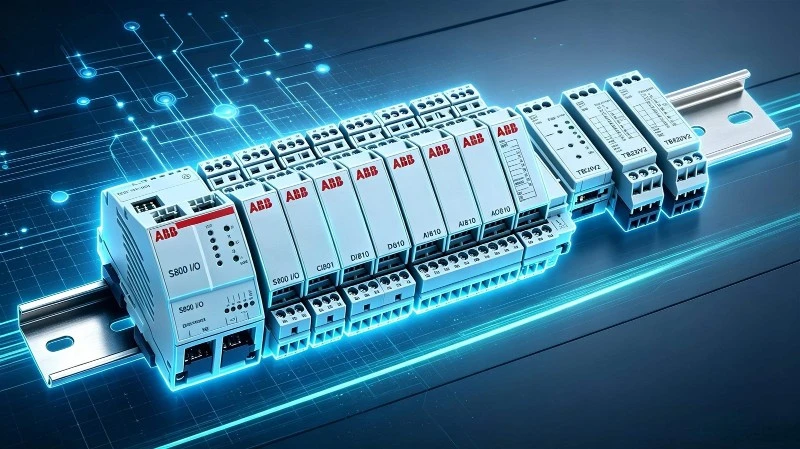
Each working station depends on the correct I/O module, Module Termination Unit, communication interface, power arrangement and controller configuration. Similar-looking parts should never be treated as interchangeable without checking the full article number. |
What Makes ABB S800 I/O More Than a Remote I/O Rack?
ABB S800 I/O is designed for plants that need to collect many kinds of signals without forcing every cable back to one central cabinet. The family communicates with parent controllers through ModuleBus or applicable industry-standard fieldbus interfaces, allowing stations to be installed close to instruments and actuators. That location choice matters because it can shorten individual cable runs, simplify marshalling and make later expansion less disruptive. The range covers common digital and analog signals, pulse and temperature measurement, while selected modules add HART pass-through, intrinsic-safety interfaces, High Integrity functions and accurate event time tagging. The result is a platform that can serve ordinary process loops and more demanding availability or safety requirements, provided the engineering team verifies the exact module and system combination.
How Does the Architecture Stay Flexible?A station can be built around the actual signal mix rather than a fixed rack formula. Field wiring lands on the matching MTU, the plug-in module handles the signal, and the communication interface moves data toward the controller. The modular path lets projects expand by process area while keeping termination and maintenance practices consistent. |
Why Do Service Features Matter?Applicable configurations support module replacement while the station remains energized, online reconfiguration and redundant paths. These features can reduce intervention time, but only when the replacement type, keying, output fallback, redundancy state and approved site procedure have been checked before work begins. |
When Is Diagnostic Depth Valuable?HART data, channel diagnostics and time-tagged events can help technicians separate an instrument problem from a wiring, communication or module fault. The benefit is strongest in continuous processes where a rushed replacement decision may create a second outage instead of restoring the loop. |
Where Does ABB S800 I/O Solve the Costliest Field Problems?
The family is useful wherever distance, signal diversity or uptime makes a simple local rack difficult to manage. Its value is practical rather than universal: the station must still match the plant network, hazardous-area rules, environmental rating and maintenance method.
Oil, Gas and Chemical UnitsContinuous-process sites can combine analog, digital and selected intrinsically safe signals while using HART and redundancy where the loop design requires them. Locating I/O nearer the process can reduce costly home-run cabling across a large unit. |
Power and Water AssetsRemote pumps, treatment trains and balance-of-plant equipment need defined behavior during communication loss and clear station diagnostics. Distributed I/O can group those signals by operating area instead of stretching individual cables back to a distant cabinet. |
Pulp, Paper and MetalsLines with drives, valves, temperature points and sequencing signals benefit from modular expansion and localized maintenance. A fault can be traced at the station level without treating every process-area symptom as a controller problem. |
Marine and Offshore SystemsProjects may require marine, environmental or hazardous-location approvals in addition to electrical compatibility. The module, enclosure, termination and complete station configuration must be checked against the rules for the vessel or offshore installation. |
How Should Engineers Select and Maintain an S800 I/O Station?
Selection should begin with the instrument list, not the appearance of an installed module. Engineers first identify signal type, range, channel count, isolation, HART, intrinsic-safety and safety-integrity needs; then they confirm the MTU, communication interface, power, redundancy, enclosure and supported controller software. Maintenance teams should record the complete ABB type designation, article number, hardware revision and terminal base before a shutdown. This workflow answers who will service the station, what the loop needs, where the hardware will operate, when replacement can occur, why a particular suffix is required and how the change will be tested.
Why does ABB S800 I/O show communication loss after a module change?
A communication alarm does not automatically prove that the new I/O module is defective. Check station power, FCI status, ModuleBus or fieldbus connections, termination, node address, controller diagnostics and configuration download first. A healthy replacement can remain unavailable when the MTU, article number, hardware revision or software definition does not match the installed station.
Can an ABB S800 I/O module be replaced without stopping the process?
Applicable S800 configurations support hot swapping, but live replacement must follow the approved plant procedure. Confirm the exact module and MTU, mechanical keying, redundant state, hazardous-area limitations and the configured output response before removal. Hot-swap capability reduces downtime only when the complete loop remains in a known safe condition.
How can buyers avoid ordering the wrong ABB S800 I/O spare?
Send the full type code, ABB article number, hardware revision, MTU designation, signal range and clear label photographs. Similar housings can hide different channel behavior, voltage ranges, isolation, HART support, redundancy capability or certification. A suffix-level comparison is more reliable than selecting by channel count or front-panel appearance.
Does every S800 I/O module provide HART or intrinsic-safety support?
No. These functions belong to selected catalog numbers and must be supported by the entire signal path. Verify the module data, MTU, communication interface, controller integration and engineering software before promising HART device access or an intrinsically safe loop. Certification and site design requirements still apply beyond the module itself.
How Can Teams Turn ABB S800 I/O Flexibility into Lower Risk?
ABB S800 I/O can reduce wiring effort and support maintainable distributed control when every part of the station is treated as one engineered chain. The safest approach is to match the real signal requirement, verify the complete hardware and software combination, document communication and fallback behavior, and keep suffix-accurate spare records. That discipline turns modularity into faster troubleshooting and controlled expansion instead of a shelf of parts that look compatible but behave differently.
Send the full module type, article number, MTU, hardware revision, quantity and delivery destination for compatibility and quotation support.
|
SALES MANAGER
Myrtle
|
PHONE / WHATSAPP
+86-18950128464 |
EMAIL
sales5@askplc.com |


